Slipping Sideways into Your World


World Building. Gah. We’re not making gingerbread houses or constructing dioramas. We’re building worlds. People, this is a task usually reserved for gods (draw whatever parallels you wish).

I’m currently knee-deep in a revision (no, wait, chin-deep…actually, I’m breathing through a straw, Scooby Doo-ish). A big part of this revision is adding texture and depth to the world of my manuscript. Before diving in, I read many craft books on the subject and originally intended to share what I learned in today’s post. Frankly, Talia covered just about everything I wanted to say.

Why, oh, why does Friday come last?

Instead, I’ll tell you a few of the tricks/tools I’ve used in this massive world building revision: Wiki entries, viewing your world as a character, and slipping things in sideways.

Wiki Entries
This is something that Veronica and I worked on while she flushed out the worlds in UNDER THE NEVER SKY. I’m using it on my current revision too and it’s hugely helpful for me. Basically, it’s a method of organizing a Story/Series Bible.

Here’s how it works:
  • Take Talia’s World Building Checklist and make each its own heading (History, Myths, Government, etc. as well as any other critical concepts you see fit).
  • For each of the headings pretend you’re generating a Wikipedia entry with respect to your world.
  • Write/Type the answers. Actually do it, don’t just think about it.
    • Content is king here, so forget style and grammar (reference the real Wikipedia and you’ll know what I’m talking about).
    • Include elements that shape your world: Such as the rules of magic, any Celtic god genealogy, lunchroom social hierarchy, maps, and research on the type of dye the Tudor court used to get the color pink…essentially, put in all you’ve got.
  • This exercise will help you identify any holes and deepen the world.
  • Also, it forced me to spell everything out, eliminating my usual, “Yeah, yeah, I know it.”
  • Use your entries as a guide when you dig into the story and explore the world.
  • And, just like Wikipedia, let it be a living document. Change things as needed. Expand. Add pictures and doodles.

View Your World as a Character
As the title implies, here, it’s all about approaching a world as if it was another major supporting character. Meaning:
  • When we develop characters, we give them contradictions, strengths, lofty desires, and irrational fears. Look around, our societies have all of that, and the good fictional ones do too.
  • Like other characters in your book, major or minor, the world helps or hinders your hero’s journey. This could be weather or geography. It could be social stigma or reactionary phobias. Shoot, it could be the traffic.
  • Boiling it down, characters and worlds need to have complex relationships.

“Slip it in sideways”
At the SCBWI LA conference this year, I was lucky enough to attend an intensive run by the master Bruce Coville. While discussing world building he used the phrase, “slip it in sideways,” and it stuck in my head. To me, it means going beyond “showing vs. telling” into the realm of having the hero interact with the environment such that the world is revealed organically and with purpose.

Wow, easy to say, but HOW? Good question. Wish I had a sufficient answer. Unfortunately, I don’t. However, I’ll throw ya some examples.  


  • Katherine wore a gore-tex scarf, a down jacket, and thick wool socks. Looking out of the frosted escape hatch, she wished she had more.
    • I never said, “It was cold.” But the world and the character are at odds here.
  • Donna cuddled with her boyfriend at an overlook above the farm. Together, they watched the sun set over the endless rows of bloody slaves.
    • Again, no mention of what sort of society Donna lived in, but (I hope) you get a sense of something sinister.
  • Talia turns off the light on her nightstand. Three thousand eighty-seven pages of testimony and not a single argument the judge will buy. Such a bigot. They’re all such bigots.
    • Here I was trying to convey Talia’s conviction and how she’s squaring up to some larger social stigma.
  • The rising hair on Veronica’s neck tickles and she smoothes it. It couldn’t be Aether again. The roses are blooming. The storms are six months away.
    • With this I attempted to convey the electrical nature of the Aether, the fact that it comes in storms, and that there’s something strange about storms coming in the summer.
Now, add a bajillion more of these and ~BAM~ you've built a world.

Okay, writing this inspired me to try a new technique: a diorama.

I’ll let you know how it goes. 


Fracture by Megan Miranda - A Bookanista Review

Description:

Eleven minutes passed before Delaney Maxwell was pulled from the icy waters of a Maine lake by her best friend Decker Phillips. By then her heart had stopped beating. Her brain had stopped working. She was dead. And yet she somehow defied medical precedent to come back seemingly fine - despite the scans that showed significant brain damage. Everyone wants Delaney to be all right, but she knows she's far from normal. Pulled by strange sensations she can't control or explain, Delaney finds herself drawn to the dying. Is her altered brain now predicting death, or causing it?

Then Delaney meets Troy Varga, who recently emerged from a coma with similar abilities. At first she's reassured to find someone who understands the strangeness of her new existence, but Delaney soon discovers that Troy's motives aren't quite what she thought. Is their gift a miracle, a freak of nature-or something much more frightening?


My Thoughts: 


From the first page, this story drew me in. FRACTURE has a beautiful dark atmosphere, well-rounded and likeable characters and a terrific sense of rising stakes. By the end, I couldn’t turn the pages fast enough.

Delaney is a character that I would love to have as a friend. She’s smart, vulnerable at times, tough and headstrong in others. I enjoyed every moment in this character’s point of view. When she made mistakes, I was riveted and worried for her—never frustrated. She felt completely dimensional to me, because we got to see her relationship with her friends, her parents, strangers. Every one of these relationships was nuanced and evolved through the course of the story. I particularly loved her relationship with her mother, which was so real and well done. Miranda broke my heart a few times with their interactions. 

I also adored Decker, Delaney’s best friend. Every time these two were on the page together, I was holding my breath. Fantastic chemistry....This is such an easy pair to love.

The story has a great balance of romance, light paranormal elements and a mystery, and as I mentioned above, it all weaves together seamlessly. FRACTURE is a quick, smart read with depth and great characters.

Highly recommended!

Check out our other Bookanista Reviews this week. (Umm... There's one in there that I recognize.)

Elana Johnson takes a shine to A MILLION SUNS
Jessi Kirby devours BITTERSWEET
Katy Upperman  ponders THE FUTURE OF US
Stasia Ward Kehoe sends Santa her YA book wish list
Shannon Whitney Messenger adores UNDER THE NEVER SKY with preorder giveaway

World Building Basics


World Building. It's a little intimidating, isn't it? I think so. But I also find it very fun, once the heavy lifting is out of the way. Here's how I did it for UNDER THE NEVER SKY.

1. Basic Premise - What is the underlying premise of the world? In Veronica Roth's DIVERGENT, society split into five factions, based on different human traits. In Beth Revis's ACROSS THE UNIVERSE, a spaceship has left a crumbling Earth for the promise of a new, better planet. In NEVER SKY, it's a future world in which people have divided into two kinds of societies, one advanced and the other primitive. These are big worlds, but you guys know that world-building can refer to a town, a highschool. Whatever the physical and social context is of your story. Make it be something, though. Your story is crying for a full, colorful canvas. 

2. Research - I couldn't travel three hundred years into the future, the time in which NEVER SKY occurs. So I read books and science journals about future technologies, and other topics that I then extrapolated from. I thought reading non-fiction for world-building was going to feel like a chore, but it was such a blast and so inspiring. I tried to also include, wherever possible, settings that I know first-hand.

3. Stare at Walls - This was a very important stage. I spent weeks letting ideas turn in my mind and then a few more weeks journaling. Little by little they began to settle into a logical order until I could see a place, a society, rules, customs. My characters, who had been waiting in the wings, suddenly stepped forward in 3D, and then the plot appeared, almost fully formed.

4. Write, Revise, Repeat - Ultimately, world-building happens on the page. It took revision after revision to get everything to fall in place. This is also the stage that brought interesting, surprising details which to me is the best part.

That's the cutest cottage I have EVER seen!

We love our characters, and we spend so much time working on story and plot. But I want to put forward the idea that context is equally important.

I mean... can you imagine this?


I forgot sunscreen!
I hate dinner parties!


  Instead of this?

In closing, have some fun with it. 

The World Building Checklist

I want to expand the concept of world building a bit.  The world of a novel consists of many aspects, so many that it is really a universe. This unique universe is populated with its own characters, settings, history, myth, beliefs, social structures, rules, politics, government, science, technology, magic, plants, animals, weather, architecture, and morality.

Depending on your genre, some of these aspects will be more important than others.  My paranormal novel takes place in a contemporary suburban community in Southern California, so that helped me check off some boxes fairly easily (setting, technology, architecture, government, weather), others required more thought (history, myth, magic, social structure, beliefs).  Some came as I wrote, others required days, weeks or even months of contemplation.  Some of the best stuff showed up between the lines, and was fleshed out in revision.

Whether you're a pantser or a planner, your novel's universe is what makes it unique.  Here is a checklist that might be helpful to review, whether your brainstorming a new novel, or putting the finishing touches on a polished draft.

Characters:  Every novel needs characters, and every character must have their own place in the world you've created. A character's unique world view is at the heart of world building.

Sometimes characters just walk into scenes, fully formed, other times we have more latitude to create them based on their role in the story.  For SPIES, I already knew my main character Berry, a teenage private investigator, would have a hard exterior.  I  pictured her as a modern day Lizzie Bennet, smart, sassy and more vulnerable than she realized.  What kind of boy could break through that wall?  What would he have to do to make her love him in spite of her better judgment?  Enter Tanner Halston. Berry would hate his good looks and over confidence.  She couldn't start to like him until he failed at something. And once I understood Tanner's failure, I  understood his place in Berry's world.

Settings:  If characters are the heart of your universe, setting is the spine. Where does the novel take place?  Sixteenth century England? Modern day Huntsville, Texas?  A future ravaged by Aether storms?  Setting is the place and time of your novel, but also the place and time of the individual scenes.  Where the action unfolds is often as important as what is happening.  The setting itself can drive the action.  Is your book set in a ruined city where the remaining human population is ravaged by viruse, or a remote island that is home to a research center committed to regulating human emotions?

The genre and concept of your novel may make certain settings seem like natural fits.  Since my novels take place in contemporary suburban settings, I look for ways to make ordinary places stand out.  In SILVER, some of the scenes are set in a coffee shop.  I could have made it a nondescript shop with comfy chairs and free wi-fi, but instead I created a Jack in the Beanstalk themed shop with a huge silk beanstalk with hanging vines that takes up most of the store.  I named the store Magic Beans and made it the place where my main character first tries her hand at magic.

Setting can be used to raise the stakes as well.  Would you see a climactic battle that takes place in someone's kitchen or on the top of a moving Ferris wheel?  Take a page from movies and think big.  The great thing about novels is you have an unlimited budget with which to create your universe, and no animals will be hurt in the making of a scene.

History: The history of your universe is as important as your main character's own backstory.  How did the world come to be this way?  How does what happened in the past influence your character's behavior?  A world's history is something that is usually revealed to me as I write, but sometimes, it is so central to a story's plot, I need to pin it down from the outset.  History and backstory are great tools to help build a mystery.  The show LOST revealed its characters' history in excruciatingly slow detail, but each revelation added a layer to the plot and kept it moving forward.  The key is to make sure the history is important to the current plot.

Myth/Beliefs:  Closely tied to history are the myths and beliefs that are held by the people in the universe.  These can be a source of conflict or serve to inform the plot (especially in fantasy and speculative fiction).  What beliefs do characters hold that are false?  What myths might be true?  How do cultural beliefs influence characters' actions?


Government/Politics:  This can be be as big as the structure of government in a dystopian society, or as small as the balance of power between best friends.  Whenever people congregate, there will be an element of political maneuvering, and imposition of authority. These power struggles infuse a novel with conflict, whether your character joins an underground rebellion against an overbearing government, or is just trying to navigate the social minefield of a high school cafeteria.  

Social Structure/Rules: Related to politics is the social structure and rules of your novel's universe. Some of these rules will be determined by your novel's setting, but your character's place in the world, will also dictate how she can behave socially.  If your writing speculative fiction or fantasy, your universe may need a set of rules of its own.  In what circumstances can magic be used?  What type of magic is permissible?  In what ways can it be used?  What are the consequences of breaking the rules?

Plants/Animals/Weather: These are all tied into setting, but any by themselves can be a focal point of your universe.  The world of JURASSIC PARK was defined by the animals that inhabited the island.  Our own V's book involves a world decimated by weather.

Magic/Technology/Science:  For fantasy and science fiction writers, the rules of magic, evolution of technology and science of the world are usually a focal point. What powers does magic or technology provide in your novel?  How does that influence the action in your story.

Morality:  Your universe has a moral code. So do your characters.  Is it line with the rest of society or different?  Does it change over time?

Architecture:  How does your world look?  Is it green and lush or do your characters live in a concrete jungle?  Are the buildings tall and lined with reflective glass or short mud huts with leaky roofs.  The architecture of your world extends beyond buildings.  What is the terrain like?  How does the world look? Smell?  Feel?  As you create your novel's world from the ground up, engage all your senses and allow yourself to visualize beyond what makes its way to the page.

Those are just a few of the things to considering as you create and polish the world of your novel?  What things would you add?

GILT winners!

Katherine Longshore 5 Tuesday, December 13, 2011
Thank you all so much for your enthusiasm and excitement about GILT.  I'm going to go all sentimental on you here and say it really has been the greatest gift this year.

And I wish I had more copies to give away -- if I could I would send one to everyone.

But the random number generator only came up with one winner for the ARC, and that is (drumroll):

Rebecca Herman!

I hope you enjoy it.

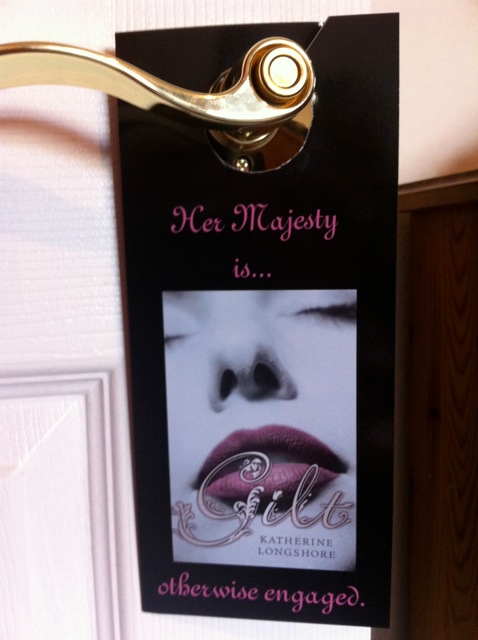
As I said yesterday, I also have three GILT doorhangers to give away to:

Vivien
Tessa
and Kai (amaterasu)

And five signed bookmarks to:

Kaye M.
Lora @ crazybookreviews
brandisbooks
Orna Ross
and Vivien

Please e-mail us at yamuses(at)aol(dot)com and I'll get these in the mail as soon as possible!

Building an Historical World

Katherine Longshore 3 Tuesday, December 13, 2011
Last night, the Apocalypsies (debut authors of YA, MG and picture books in 2012) had a Twitter chat on world-building.  We chose the topic because it transcends genre.  Every author has to build a believable world in which to set the story -- one that even becomes part of the story -- whether that setting is contemporary, historical, futuristic or in a different dimension.  It is so enlightening to hear other writers talk about what they write, about what works and doesn't work, and what inspires them.  This is one of the reasons I love this blog, and reading everyone else's posts, and reading all of your comments.  It keeps things fresh (and makes me feel like less of an oddball).

But because I write historical novels, I'm going to write about building an historical world.  There is only so much I can learn by reading, and so much I can learn by visiting historical sites today.  Somehow they have to come together, with a touch of something a little less sterile than research.

Which is good, because the Tudor world was anything but sterile.  It's fun to watch dramas set in Tudor times (though I haven't watched more than two episodes of the Tudors -- I didn't want them to influence my own character-building -- I do enjoy a good Elizabethan drama these days!).  And to see how beautiful and clean everything looks.

Things were not clean.  Men and dogs peed against the walls of the great halls and courtyards of palaces.  Mud must have been everywhere.  There was no escape from lice and bedbugs and fleas -- Henry VIII thought that sleeping with piece of fur under his pillow would protect him.  That the bugs would latch onto the fur instead.  Most clothing items couldn't be laundered -- just the thin linen garments worn underneath the heavy doublets and bodices and skirts.  But if everyone smelled, perhaps you just didn't notice?

When I think about this world, I conjure up some of the smells I encountered while traveling.  The odor of a sewer in a tropical third world city was probably similar to that of the River Thames in the 16th century.  The eerie, damp reek of an African public toilet (seriously, avoid them at all costs) could probably be likened to the 14-seater lavatory at Hampton Court Palace.  I remember these things and then temper them -- because we don't want all our illusions shattered at once, do we?  Tudor times were so romantic.

And it was dark.  I have to remember camping trips in high mountains to be able to imagine how dark it would have been.  No streetlights.  No airplanes.  Few lighted windows.  People went to bed when it got dark because candles were expensive.  Only the rich could afford to have late parties -- and even they were probably dimly lit -- cavernous spaces barely penetrated by torches and candles.  And all of the lighting would have smoked -- causing a haze and (yes) smell.  Tallow candles for the poor stank of...well...fat.  Beeswax candles used by the rich probably smelled better.

But the things that intrigue me most -- and that I try my best to build into my world -- were the gaudy fabrics and blindingly colorful tapestries.  The remnants of these that we see today are probably but pale shadows to what the palaces really looked like.  The tapestries were huge, detailed and colorful.  Henry's would have had silver and gold threads throughout -- another sign of wealth.  And the clothing would have rivaled them.  Dyes were outrageously expensive, and people liked to make an impressive show (kind of like the Oscars or the Grammys today, but showing less skin).  I want to use this gaudiness to balance what we would probably think of as squalor.  And then try hard not to pass 20th century judgement.

I love the world my characters inhabit.  It is strange and frightening and repulsive and beautiful.  I would never want to live there.  But I have fun building it.

GILT (and More) to Giveaway!

Katherine Longshore 2 Monday, December 12, 2011
Most of you already know about our giveaway of the Advance Reading Copy of GILT.  And thank you all so much for your enthusiasm and encouragement!

Because you are all so kind, I want to add a little more to the giveaway.  I wish I had more than one ARC, but since I don't, I'll be giving away three GILT-themed door hangers and five signed bookmarks as well.  But hurry, the contest ends at 12 midnight EST.  Comment, tweet with the #giltnovel hashtag or make a Facebook post to enter.  Full details here.

However, there is another special treat for you today and another giveaway happening tonight!  Our own Veronica Rossi will be featured in the Apocalypsies Twitter chat at 9 p.m. EST. She will be giving away a signed final copy of UNDER THE NEVER SKY and also a 30-page critique.  So be there with bells on, and remember to use the hashtag #2012debuts!

And as if that isn't enough, Donna Cooner kicked off our World Building Week with a kick-ass post on the contemporary world of SKINNY.  What a way to start the week, right?

Contemporary World Building


This week the Muses topic is "World Building." I don't write books with deadly skies, or historical castles, or magical beaches with doors to the underworld or time robbers --so world building to me is a bit different. The world of my books is the everyday world around me, so making it come alive and become "real" to readers is an even bigger challenge sometimes. (Ok, I know some of the Muses are going to disagree with me on that one). I have to admit, though, that part of the creating is the fun part for me. It's all in the quirky, specific details. And I LOVE quirky - both in setting description and in character.

Here's a few teasers from SKINNY to illustrate my point:
We pass the Walmart on the right and then McKenzie’s BarBQ on the left. It doesn’t take long to get anywhere in this town. An hour north of Houston, Huntsville sits on the edge of the East Texas Piney Woods and has some odd extremes when it comes to attractions. Visitors can go to the Texas Prison Museum and see “Old Sparky,” the electric chair that killed 361 condemned criminals over forty years of service, or head south of town to view the world’s tallest statue of an American hero — Sam Houston. Rat’s dad is a ranger for the Sam Houston Park. His mom, an elementary school teacher, was my mom’s best friend from the moment we moved in next door to them. I still see the grief in Mrs. Wilson’s eyes when she looks at me...We pass Tinsley’s Fried Chicken with the big sign outside that reads, Try Our Big, Juicy Breasts.

“They really should change that sign,” I say.


And another example:
We slowly pass a yellow house on the corner with overgrown dandelions and a FOR SALE sign in the front yard. It belonged to the Cat Lady, Mrs. Rattenborg. They found her two weeks after she slipped in the bath and died from hitting her head on the Siamese-cat-shaped soap dish. The animal control people were taking crates of cats away for days. I think the moral of the story is, if you’re going to wind up in life with only cats for friends you should teach them to dial 911.

And a final example:
Charlotte comes in from the backyard carrying a freshly cut bouquet of yellow roses from the yard. Carefully slicing each stem off at the perfect angle, she arranges them symmetrically into a vase, equal spaces apart. Charlotte likes things orderly. Even flowers. The three different bottles of perfume she keeps on the top of her dresser are exactly lined up, even spaces apart, right next to the wooden plaque that reads, GOD ISN’T FINISHED WITH ME YET. There’s also a pyramid of large pink Velcro rollers on the dresser top, perfectly stacked, that has something to do with her daily hair routine, but I haven’t quite figured that out yet.


So what do you add to your world to make it "quirky" and real?
Grid_spot theme adapted by Lia Keyes. Powered by Blogger.

Search

discover what the Muses get up to when they're not Musing

an ever-growing resource for writers

Popular Musings

Your Responses

Fellow Musers

Translate